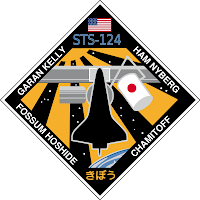
Only ten more shuttle launches to go after this one. Yesterdays launch was flawless with perfect weather. It is always exciting to see a shuttle launch.
I was poking around on the NASA web site and came across a page that described in detail what happens during the launch countdown. The countdown actually begins about four days prior to launch. This is taken directly from the NASA
website.
The Countdown Clock is one of the most-watched timepieces in the world. On this page, you'll learn how the countdown operates, and what milestones to watch for during our Live Launch Coverage.

Image to left: Spectators gather on the grounds in front of the countdown clock during a Space Shuttle launch. Credit: NASA
Here are some of the key events that take place at each milestone after the countdown begins. Note: Event times and lengths are approximate and subject to change.
T-43 hours and countingThe Shuttle Test Director performs the traditional call to stations and the countdown clock is activated.
Begin final vehicle and facility close-outs for launch
Check out backup flight systems
Review flight software stored in mass memory units and display systems
Load backup flight system software into the orbiter's general purpose computers
Remove middeck and flight deck platforms
Activate and test navigational systems
Complete preparation to load power reactant storage and distribution system
Complete flight deck preliminary inspections

Image to right: The Space Shuttle launch team seated in Kennedy's Firing Room 1.
Credit: NASA
T-27 hours and holdingThis is the first built-in hold and typically lasts four hours.
Clear launch pad of all non-essential personnel
T-27 hours and countingBegin operations to load cryogenic reactants into the orbiter's fuel cell storage tanks
T-19 hours and holdingThis built-in hold typically lasts four hours.
Demate the orbiter's midbody umbilical unit
T-19 hours and counting Begin final preparations of the orbiter's three main engines for main propellant tanking and flight
Fill launch pad sound suppression system water tank
Resume orbiter and ground support equipment close-outs
Close out the tail service masts on the Mobile Launcher Platform
T-11 hours and holdingThis built-in hold varies in length, but typically lasts 12 to 13 hours.
Flight crew equipment late stow
Move Rotating Service Structure (RSS) to "park" position
Activate the orbiter's inertial measurement units and communications systems
Perform ascent switch list

Image to right: The Rotating Service Structure (RSS) is rolled slowly into the "park" position, revealing Space Shuttle Atlantis as the launch countdown for STS-98 enters its final hours. Credit: NASA
T-11 hours and countingActivate the orbiter's fuel cells
Clear the blast danger area of all nonessential personnel
Switch the orbiter's purge air to gaseous nitrogen
T-6 hours and holdingThis built-in hold typically lasts two hours.
Launch team verifies no violations of launch commit criteria before loading the External Tank with propellants
Clear pad of all personnel
Chill-down of propellant transfer lines
Begin loading the External Tank with about 500,000 gallons of cryogenic propellants
T-6 hours and counting Finish filling the External Tank with its flight load of liquid hydrogen and liquid oxygen propellants
Final Inspection Team proceeds to the launch pad to conduct a detailed analysis of the vehicle as the team walks up and down the entire launch tower
T-3 hours and holdingThis built-in hold typically lasts two hours.
Perform inertial measurement unit preflight calibration
Align Merritt Island Launch Area (MILA) tracking antennas
T-3 hours and counting Crew departs for the launch pad and, upon arriving at the pad, begins entry into the orbiter via the White Room
Complete close-out preparations in the launch pad's White Room
Check cockpit switch configurations
Astronauts perform air-to-ground voice checks with Launch Control (Kennedy Space Center) and Mission Control (Johnson Space Center)
Close the orbiter's crew hatch and check for leaks
Complete White Room close-out
Close-out crew retreats to fallback area
T-20 minutes and holdingThis built-in hold typically lasts 10 minutes.
Shuttle Test Director conducts final launch team briefings
Complete inertial measurement unit preflight alignments

Image to left: Space Shuttle Discovery waits to launch on mission STS-103. At the top is the External Tank gaseous oxygen vent arm system with the vent hood (sometimes called the "beanie cap") poised above the External Tank. Extending toward the cabin of the orbiter below is the orbiter access arm, with the White Room at the end. Credit: NASA
T-20 minutes and counting Transition the orbiter's onboard computers to launch configuration
Start fuel cell thermal conditioning
Close orbiter cabin vent valves
Transition backup flight system to launch configuration
T-9 minutes and holdingThis is the final built-in hold, and varies in length depending on the mission.
The Launch Director, Mission Management Team and Shuttle Test Director poll their teams for a go/no go for launch

Image to right: A fish-eye view captures Space Shuttle Endeavour just after liftoff on mission STS-111. Credit: NASA
T-9 minutes and counting Start automatic Ground Launch Sequencer
Retract Orbiter Access Arm
T-7 minutes, 30 secondsStart Auxiliary Power Units
T-5 minutes, 0 secondsArm Solid Rocket Booster range safety safe and arm devices
T-5 minutes, 0 secondsStart orbiter aerosurface profile test, followed by main engine gimbal profile test
T-3 minutes, 55 secondsRetract Gaseous Oxygen Vent Arm, or "beanie cap"
T-2 minutes, 55 secondsCrew members close and lock their visors
T-2 minutes, 0 secondsOrbiter transfers from ground to internal power
T-50 secondsGround Launch Sequencer is go for auto sequence start (T-31 seconds)
Activate launch pad sound suppression system
T-16 secondsActivate main engine hydrogen burnoff system
T-10 secondsMain engine start (T-6.6 seconds)
T-0Solid Rocket Booster ignition and liftoff!
Image above: Space shuttle Discovery thunders off the launch pad at NASA's Kennedy Space Center in Florida. Photo credit: NASA TV